There are some festivals we celebrate. And then there are festivals we simply feel.
Onam, for me, has always been one of those festivals.
For ten days, Kerala seems to dress itself differently. Flowers appear everywhere in colourful Athapoovalam, people bring out their traditional attire, swings are decorated and hung up, delicious food begins to find its way into every conversation, and there is a certain festive energy in the air that is difficult to explain to someone who hasn’t experienced it.
For those of us in Kerala—and for Malayalees all over the world—Onam is much more than a day marked on the calendar. Though it has its roots as a harvest festival, it has grown into a celebration of togetherness, bringing families, friends, colleagues and communities together.
This year, I got to experience that feeling in two very different places—at my research centre and at home.
Table of Contents
Onam at my Research Centre
My PhD journey is usually filled with books, papers, research work, deadlines and the occasional feeling that there is always something more to be done! 😊
So, when the Onam celebrations arrived at my research centre, it was lovely to put all of that aside for a while and simply enjoy the festive spirit.
Our celebrations were spread over two days, with plenty of colour, laughter and activities.
The celebrations were inaugurated by cine artist Karamana Sudheeran, setting the mood for what turned out to be two wonderful days.
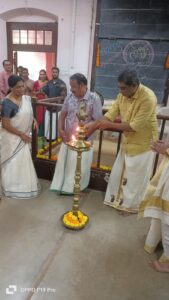
There was, of course, the traditional lighting of the nilavilakku, followed by the beautiful Athapookkalam, the ever-popular Oonjal, energetic Vadamvali (tug-of-war), and several other games.
The Athapookkalam deserves a special mention. Watching flowers arranged into beautiful patterns is one of those simple Onam traditions that never seems to lose its charm. Each day of the ten-day celebration beginning with Atham brings its own colours and patterns, leading up to Thiruvonam, the main day of Onam.
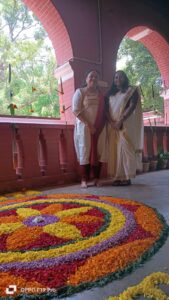
And then there was the Oonjal.
How could I possibly resist it? 😊
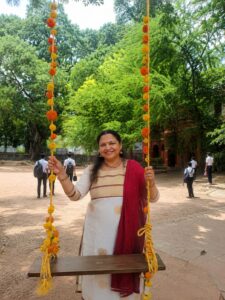
For a little while, I wasn’t thinking about my research, my PhD or everything that still remains to be done.
I was simply enjoying the swing.
Sometimes, perhaps, that is exactly what we need—a few moments when we allow ourselves to stop working towards something and simply enjoy where we are.
A little colour, a little tradition, a lot of happiness
There is something particularly beautiful about seeing everyone dressed in traditional Kerala attire during Onam.
The set-mundu and traditional Kerala sarees, the white and gold, the colours of the flowers, the smiles, the photographs and the inevitable “one more picture!” moments—all of them become part of the celebration.
And then, of course, there was Maveli.
According to the beloved Onam legend, King Mahabali, or Maveli, returns to Kerala once a year to see his people—the subjects he once ruled over in an age remembered for prosperity, equality and happiness.
That is why the image of Maveli has become inseparable from Onam.
Having Maveli among us made the celebration even more fun!
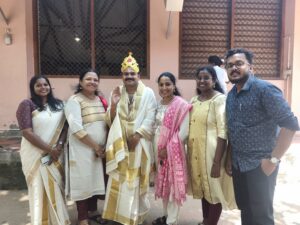
There were photographs, conversations, games and those little spontaneous moments that may not appear in any official programme—but are often what we remember most.
And then came Vadamvali!
If there is one thing that can instantly turn a peaceful gathering into a highly competitive event, it is Vadamvali! 😄
The tug-of-war brought out everyone’s competitive spirit.
For those few minutes, titles, designations and everyday responsibilities disappeared. There were only two teams, one rope and a lot of determination!
And that, too, is part of the magic of festivals.
They remind us that beneath all our roles—researcher, teacher, colleague, parent, professional—we are simply people who enjoy laughing, playing and being together.
And finally… the Onasadhya!
And what is Onam without Onasadhya?
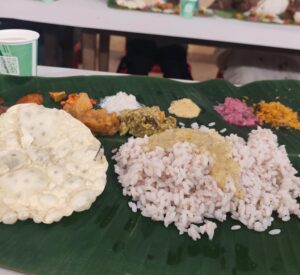
A traditional Kerala sadhya served on a plantain leaf is not merely a meal. It is almost an experience in itself.
Rice, curries, thoran, avial, olan, kootu curry, pickles, pachadi, payasam and so many other dishes—each finding its own little place on the leaf.
And somehow, no matter how full you think you are, there always seems to be room for payasam. 😉
Our Onam celebrations at the research centre ended, as they should, with a sumptuous Onasadhya and a very happy bunch of people.
And then… Onam at home
The celebrations didn’t end there.
Onam at the research centre was about colleagues, friends and community.
Onam at home was about family.
And perhaps that is one of the things I love most about this festival.
The setting may change. The people may change. The scale of the celebration may change.
But the essence remains the same:
Come together. Share a meal. Laugh. Celebrate. Make memories.
For someone navigating a PhD alongside all the other responsibilities and chapters of life, these moments of togetherness feel particularly precious.
There will always be another paper to read.
Another chapter to work on.
Another deadline.
Another task waiting.
But festivals like Onam gently remind us that life cannot be measured only by the work we complete.
Some of it has to be measured by the moments we live.
More than a festival
Perhaps that is why Onam continues to hold such a special place in the hearts of Malayalees, wherever they may be in the world.
It is about homecoming.
It is about belonging.
It is about flowers arranged on the floor, a swing moving gently, the sound of laughter during a game, the elegance of traditional attire, a little Maveli magic, and a plantain leaf filled with food.
It is about finding time for one another.
And this year, somewhere between my books, my research and my PhD journey, I found a little time to simply celebrate.
To laugh.
To dress up.
To swing.
To eat.
To be with people.
And to remember that while I am working hard to build the future I dream of, I should also pause occasionally and enjoy the present I am living.
That, perhaps, is my Onam lesson this year.
Happy Onam! 🌼❤️
More Onam this season: OSA Onam Celebration 2026: An Unforgettable Reunion and More Than an Onam Celebration. Learn more about Onam from Kerala Tourism.
Pingback: OSA Onam Celebration 2026: An Unforgettable Reunion.
Pingback: Onam Celebration at Our Toastmasters Club: 1 Joyful Day